Features · Inventory
Warehouse management — set up once, run every day
A warehouse system earns its keep twice: on day one, when products, units, and locations are set up right — and every day after, when goods move against contracts instead of against memory. This page is about both.
01
The setup: products, types, units, warehouses
In business settings you define product types, the products themselves — with cost method, price, opening stock, and counting unit — and your warehouses. Get this hour right and every later movement lands in a structure that makes sense.
- Product types & products
- Cost method & units per item
- Opening stock per warehouse
- Definitions live in settings
Stock by warehouse
Bangkok WH
248 units
Chiang Mai WH
96 units
Rayong WH
512 units
02
The daily run: goods move against contracts
Outbound follows sales contracts' delivery plans; inbound follows purchase contracts' receiving plans — confirmed singly, in batch, or via Excel. Nothing enters or leaves as a loose event; the contract behind each movement is always one click away.
- Outbound per delivery plans
- Inbound per receiving plans
- Single, batch & Excel confirmation
- Contract one click away
Purchase contracts
Payment plan generated — 6 periods
Pay to accountKBank •••4512
Period 1 · Sep 30฿206,666
03
The oversight: queries, alerts, and the dashboard
Stock queries show flows, per-warehouse quantities, and per-item details; low-stock alerts fire per product; and the data center's supply-chain view adds value, receiving timeliness, turnover, and shortage prediction on top.
- Stock flow & balance queries
- Per-product low-stock alerts
- Supply-chain dashboard view
- From daily ops to insight
Sales revenue — last 6 months
Revenue · Aug
฿4.2M
+18% vs last month
Gross margin
32.4%
Overdue receivables
฿310K
-22% vs last month
Inside the module
Real screens from Flows ERP — what your team will actually work in.
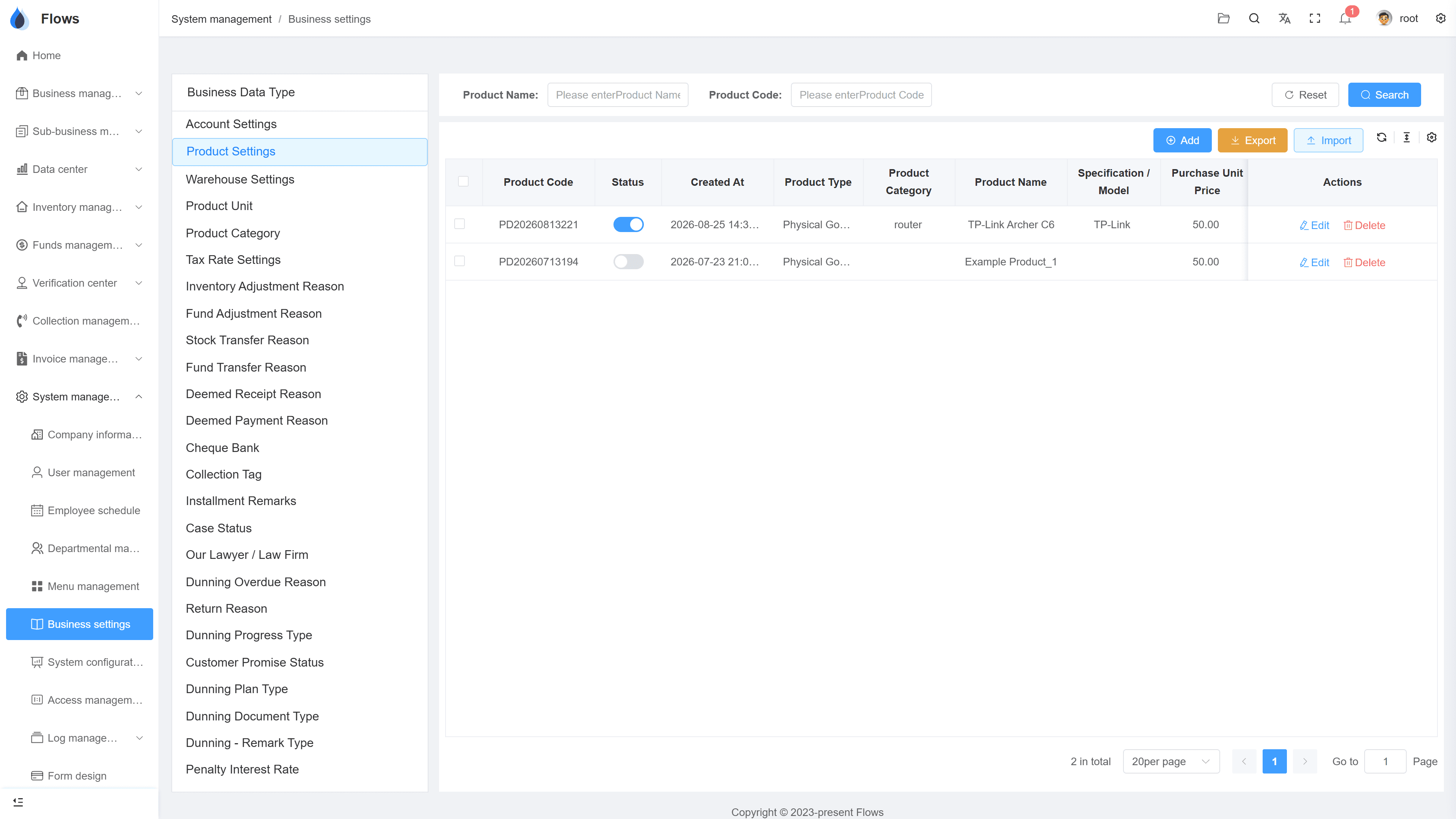
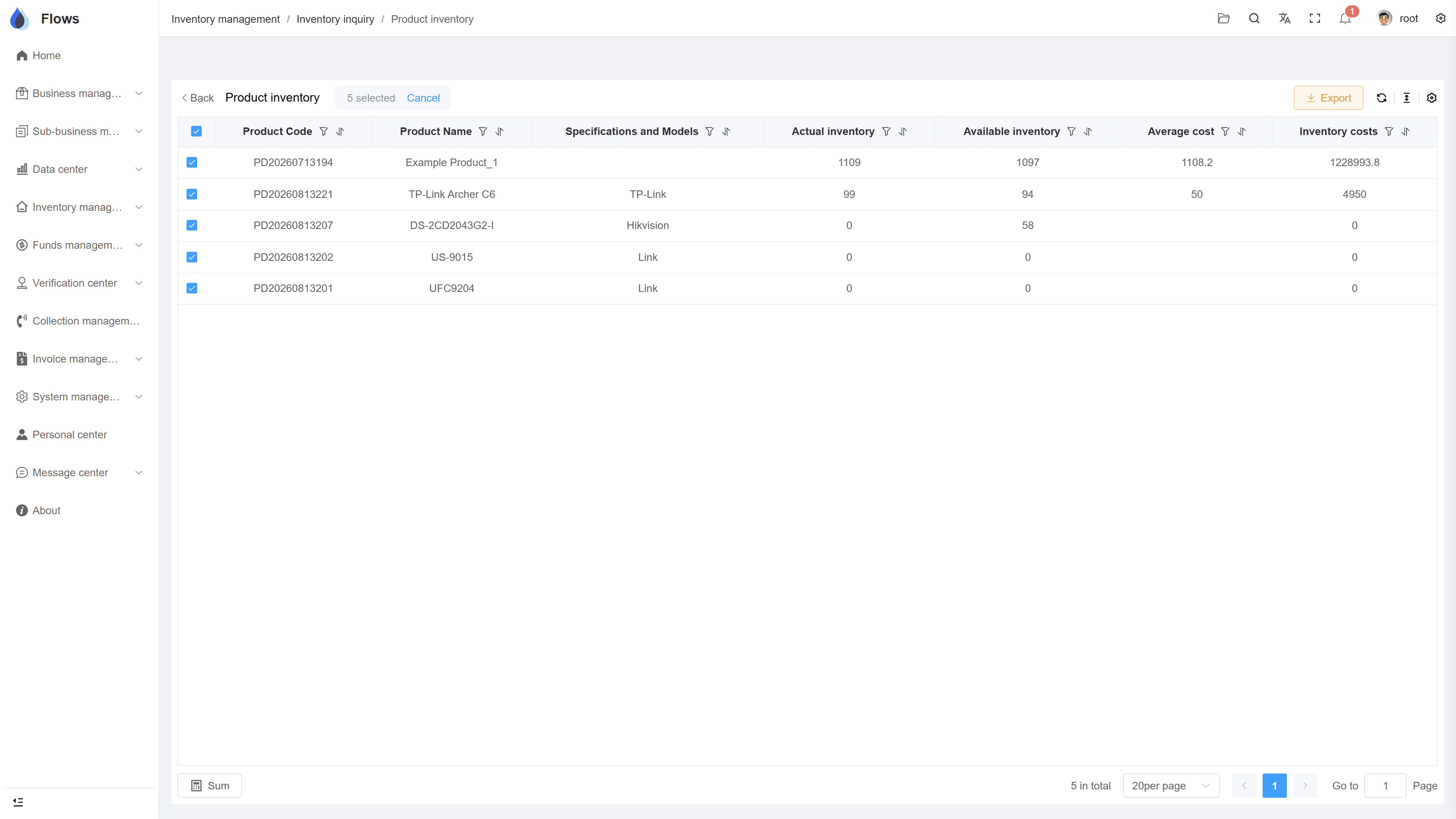
Product setup
A product with its cost method, price, unit, and opening stock — the foundation everything moves on.
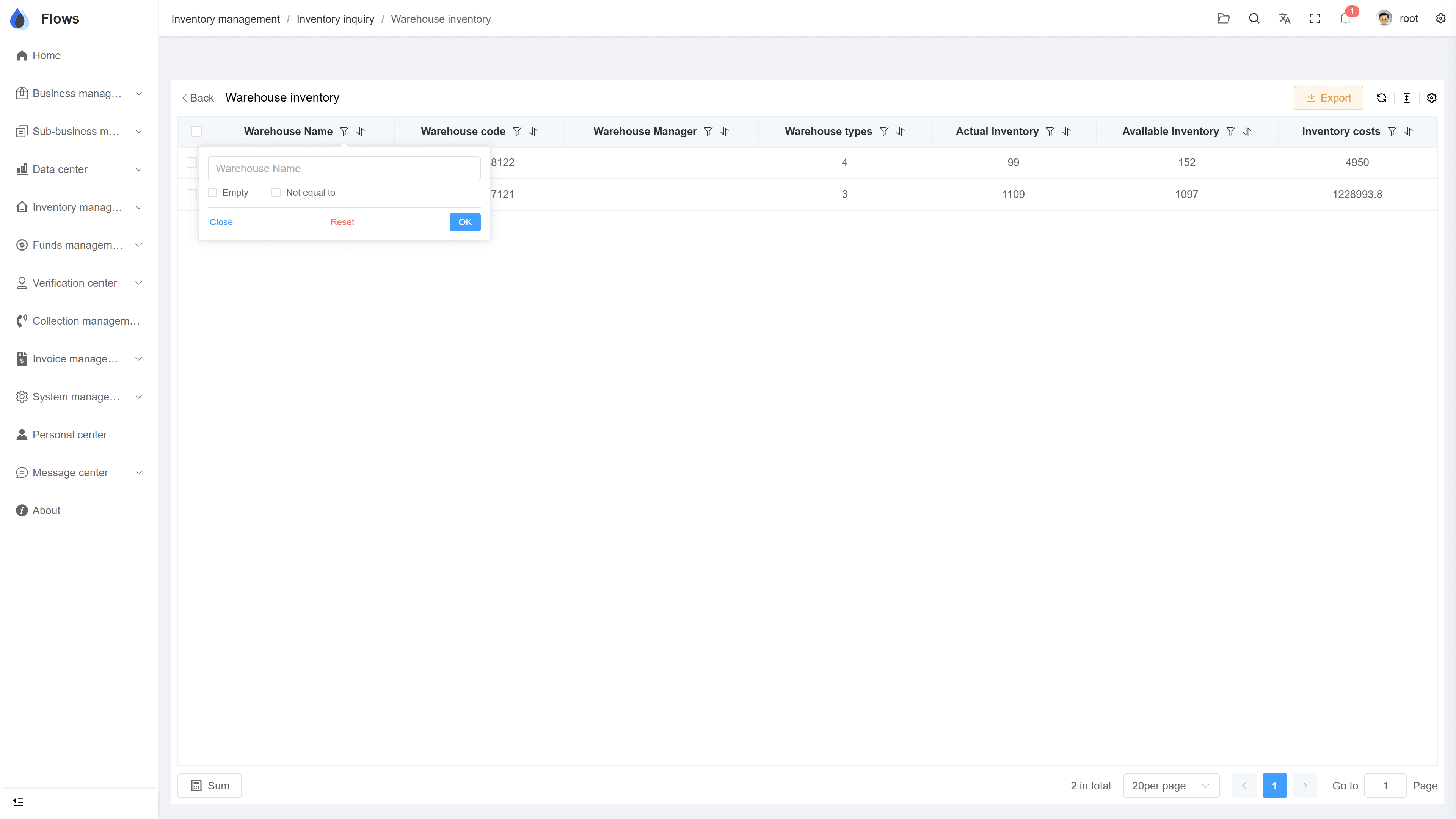
Stock query view
Balances and movements across warehouses — the answer screen for 'what do we actually have?'.
Why Flows
What makes Flows different
Not another generic ERP — a system built around how Thai SMEs actually buy, sell, and collect.
See how onboarding works →Priced per company, not per seat
One annual price, every module included. Add users freely within your tier — no feature gates, no seat fees.
Three languages with auto-translation
Thai, English & Chinese UI — and the data your team enters is translated automatically, so everyone reads the same records.
Your documents, exactly your format
Send us your invoice and receipt templates; our team configures them into Flows. Every document comes out looking like yours.
We walk you live — and stay
Five-step onboarding at no extra cost, then quarterly system stability reports. We don't disappear after go-live.
Spec sheet
What warehouse management ships with — included in every plan.
Setup
Product types, products, units, warehouses — in settings
Costing
Cost method and price per product
Movements
Against contracts: single, batch, or Excel
Queries
Flows, per-warehouse balances, per-item detail
Alerts
Low-stock minimums per product
Corrections
Transfers, returns, adjustments — with reasons
Ledger
Stock cards per item per warehouse
Insight
Supply-chain dashboard in the data center
Frequently asked questions
Is Flows a WMS (warehouse management system)?
It's an ERP whose inventory module covers what most SMEs need from a WMS — product setup with costing and units, multi-warehouse balances, contract-driven movements, transfers and returns, alerts, and stock cards — with the advantage that goods and money live in one system.
What do we set up before using the warehouse module?
Product types, the products themselves (cost method, price, unit, opening stock), and your warehouses — all in business settings, usually during onboarding with our team alongside.
How does stock move day to day?
Against contracts: outbound confirmations follow sales contracts' delivery plans, inbound follows purchase contracts' receiving plans — singly, in batch, or via Excel. Corrections (transfers, returns, adjustments) have their own recorded paths.
Which cost information does a product carry?
Its cost method, price, and counting unit — set at product creation and used consistently in contracts, movements, and the supply-chain view's stock valuation.
How is this page different from the multi-warehouse page?
Multi-warehouse focuses on running several locations — splits, transfers, per-site views. This page covers the system as a whole: the setup that makes it trustworthy and the daily contract-driven operation.
Can we start with stock from our old system?
Yes — import products and opening balances via Excel templates with validation, per warehouse, during onboarding's parallel-run week.
Set your warehouse up right, once.
Start a free one-month trial, or book a demo with your product list — we'll structure it together.