Features · Platform
The form designer — your fields on the real forms
Every business tracks something the standard form doesn't have: a project code, a vehicle number, a broker's name. In Flows you add those fields to the system's forms yourself — and they behave like built-in fields, not like notes scribbled in a comment box.
01
Add the fields your business actually uses
Open business settings, pick the form — customers, contracts, products — and add your fields. A construction contractor puts a project code on every contract; a machinery trader adds serial numbers; a leasing firm tracks a guarantor contact. No custom development, no waiting for a vendor.
- Fields on the forms you choose
- Added in settings, not in code
- Ready the moment you save
- As many fields as you need
Platform — system settings
API · data received from an external system
Button-level permissions on every action · fully logged
02
Custom fields behave like built-in ones
A field worth adding is worth searching by. Your custom fields show on the record, work in filters and searches, and travel through Excel exports — so 'all contracts for project A23' is a filter, not an archaeology project.
- Visible on the record detail
- Usable in filters & search
- Included in Excel exports
- Same permissions layer applies
Contract SC-2026-041 · Bangkok Trading
@Somchai please follow up period 3
Logged on the contract · visible to the team
03
Set up with you, honest about its limits
During onboarding we define the fields together — it's step three of the five-step path. And an honest boundary: the designer customizes the forms of Flows' modules. If you need a whole new workflow or module, that's a custom-development conversation, not a checkbox.
- Defined together at onboarding
- Adjustable later in settings
- Forms of existing modules
- New workflows = custom dev, quoted
Customer — Bangkok Trading
@Somchai customer visit set for Thursday
Visible to the sales team only · full edit history
Inside the module
Real screens from Flows ERP — what your team will actually work in.
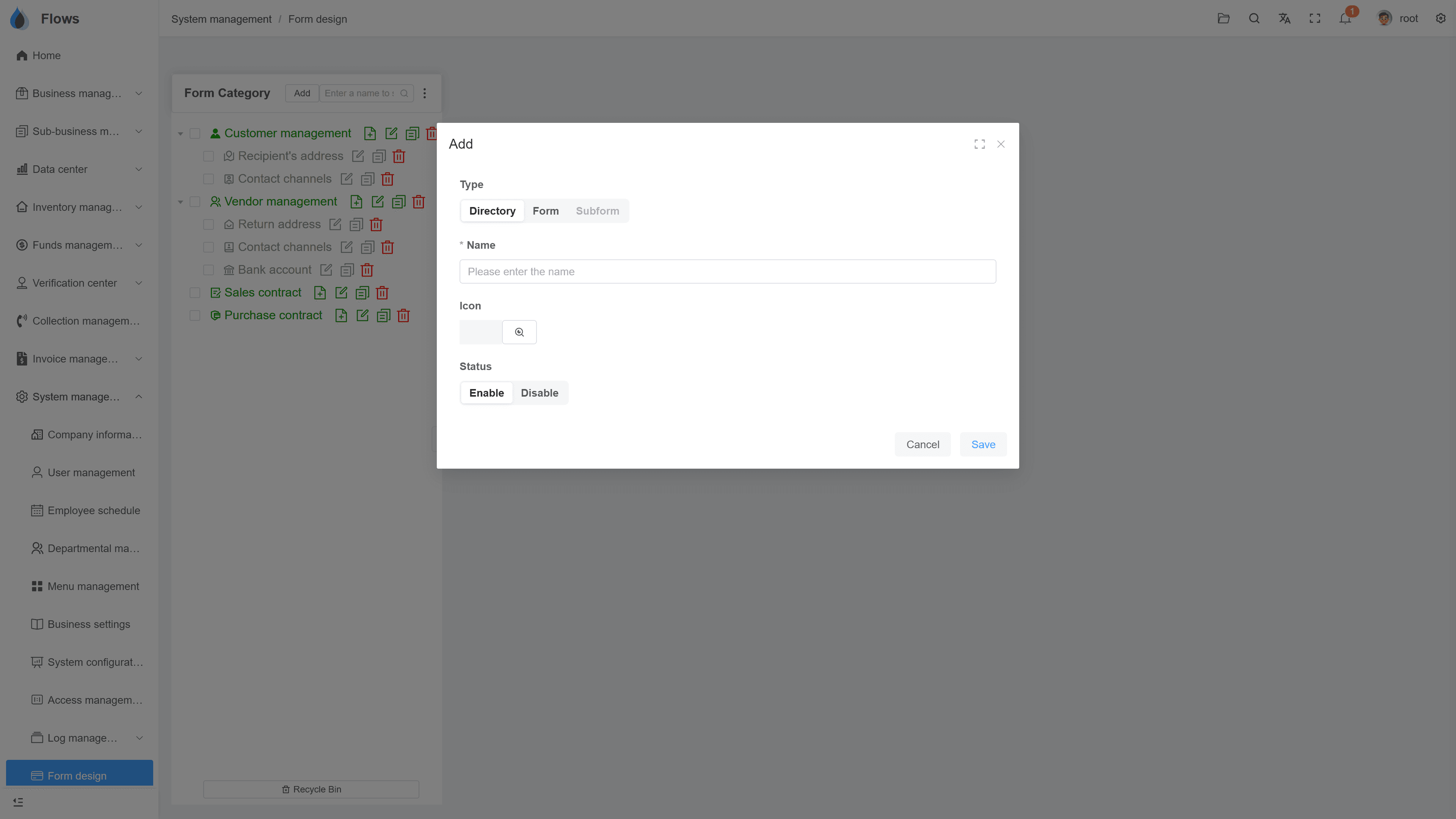
Adding a field to a form
Pick the form, name the field, choose its type — the change applies to new and existing records.
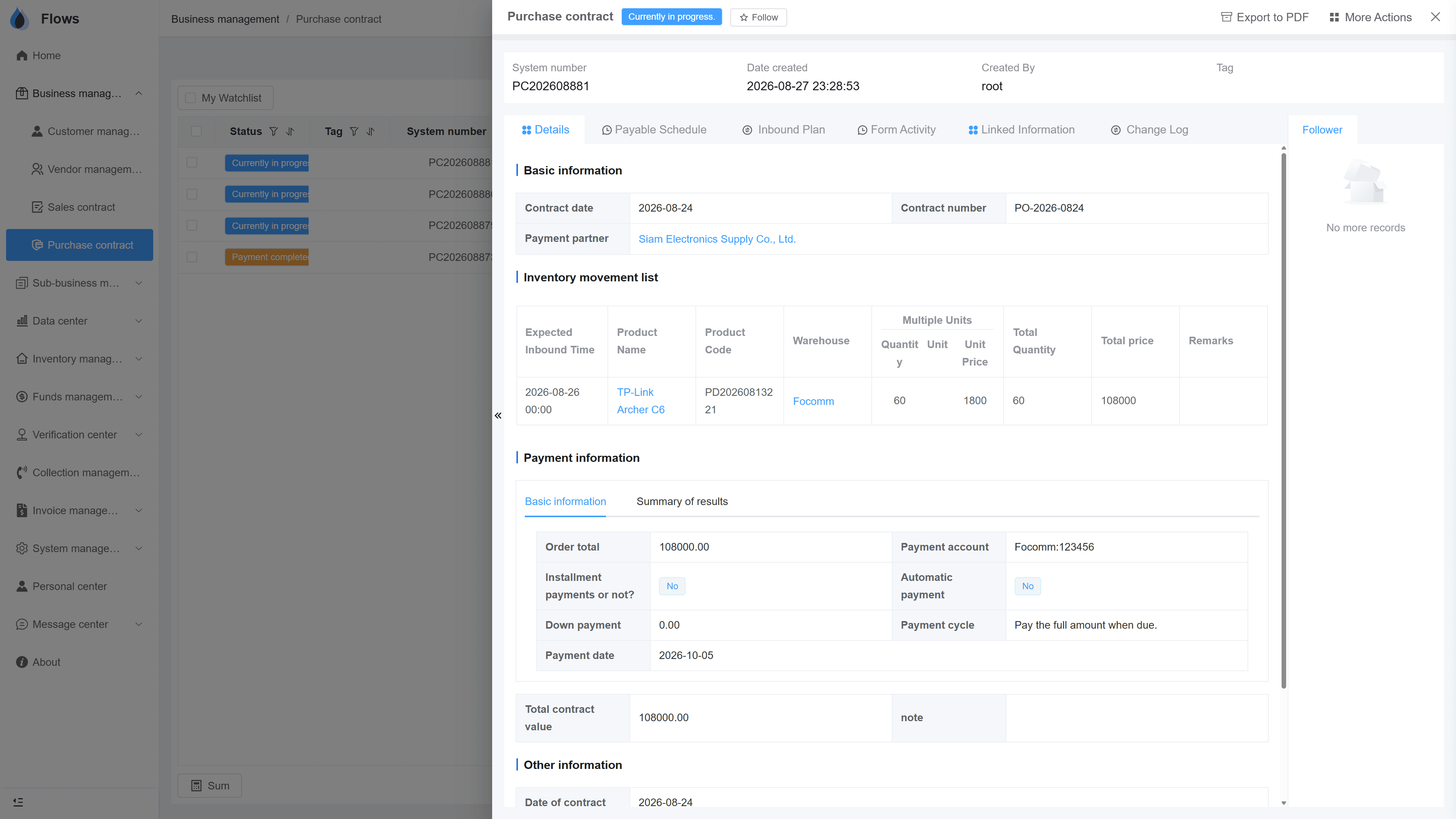
A custom field in use
The project code on a real contract — filled in, filterable, and exported with everything else.
Why Flows
What makes Flows different
Not another generic ERP — a system built around how Thai SMEs actually buy, sell, and collect.
See how onboarding works →Priced per company, not per seat
One annual price, every module included. Add users freely within your tier — no feature gates, no seat fees.
Three languages with auto-translation
Thai, English & Chinese UI — and the data your team enters is translated automatically, so everyone reads the same records.
Your documents, exactly your format
Send us your invoice and receipt templates; our team configures them into Flows. Every document comes out looking like yours.
We walk you live — and stay
Five-step onboarding at no extra cost, then quarterly system stability reports. We don't disappear after go-live.
Spec sheet
What the form designer ships with — included in every plan.
Forms covered
Customers, suppliers, contracts, products, and more
Field setup
In business settings — no code, no vendor ticket
Behavior
On the record, in filters, in Excel exports
Quantity
As many custom fields as the business needs
Permissions
Button-level access control applies to custom fields
Onboarding
Fields defined together in step 3 of onboarding
Changes
Add or adjust fields later in settings
Boundary
New modules/workflows are custom development, quoted per project
Frequently asked questions
Do custom fields require a developer?
No — fields are added in business settings by an admin. Custom development only enters the picture when you need a whole new workflow or module, which is quoted separately.
Which forms can be customized?
The forms of Flows' modules — customers, suppliers, sales and purchase contracts, products, and related records. You pick the form and add the fields it's missing for your business.
Do custom fields work in filters and Excel exports?
Yes — that's the difference between a real field and a note. Custom fields appear on the record, filter and search like built-in fields, and are included when you export to Excel.
Can we build entirely new modules with the form designer?
No — and we'd rather tell you that here than after you've bought. The designer customizes existing forms. New modules or workflows are custom development, scoped and quoted per project.
Who sets the fields up?
Either your admin in settings, or together with the Yangshu team during onboarding — defining your fields is step three of the five-step onboarding path, so most companies go live with their fields already in place.
What happens to existing records when we add a field?
They stay intact and simply gain the new empty field, ready to be filled in — by hand or via an Excel import of the new column.
Put your fields on the form.
Start a free one-month trial, or book a demo and bring your field list — we'll add one together, live.