 Yangshu
Is AI a Bubble? Why It Will Burst, When, and What Survives — Yangshu's Five Judgments
The AI hardware trade is a bubble. The technology is not. Five judgments on why it bursts, when it bursts, and what's still standing afterwards
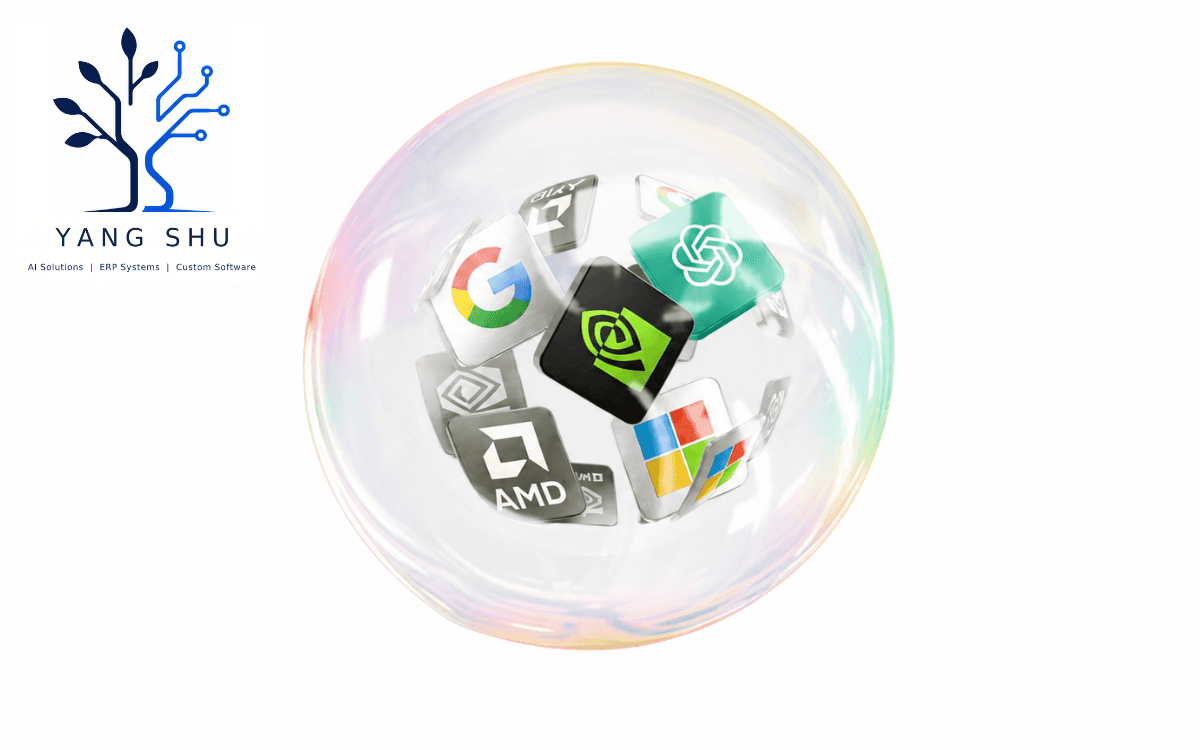
In short: the stock prices the AI boom has created are a bubble. The technology itself is not. These two things have to be judged separately. When the dot-com bubble burst in 2000, it destroyed valuations and companies — not the internet. Bubbles pop. Technology stays.
Yangshu Co., Ltd is a custom enterprise software developer based in Thailand with R&D centers in both Thailand and China, building vertical ERP systems (Flows for sales and leasing, Vet Manbi for veterinary clinics), industrial optimization software, applied AI, and RPA automation. We came up building ERP systems, and we have followed and used AI continuously since GPT-4 was released on 14 March 2023. Precisely because we use it every day, we need to be clear about something: believing in a technology and believing in its current price are two different things.
This piece was written in July 2026. It reflects our observations as of that date and is not investment advice.
1. Why is the technology itself not a bubble?
Because it is already good enough to substitute for human thinking — even though it is only imitating it.
The invention and refinement of the steam engine started the Industrial Revolution: machines replaced human hands. AI is now doing the other half of that job.
We should be honest about what AI is. It cannot truly think. Its answers come from a mathematical model predicting, by probability, what the next word (token) should be. But consider this from another angle: the external expression of human thought is language and text. In that sense, AI is an "imitation of intelligence."
And here is the point that matters — imitation or not, it is already good enough to replace human thinking.
Human employees need to eat, rest, and socialize. A large model running on a GPU does not. That is the equivalent of several billion independent brains appearing in the world out of nowhere.
We are still at an early stage. How far AI will go and what it will eventually solve, Yangshu cannot predict. But one possibility deserves to be taken seriously: the tokens AI produces are themselves intelligence, thought, and creation — and they are being sold as a commodity. The product companies like OpenAI and Anthropic sell in the future may simply be intelligence itself.
That will reshape economic activity. The most direct consequence: the returns to capital and the returns to labor will diverge further. People who own assets will get richer. People who can only sell their time will get poorer.
There is an optimistic version too — a future where nobody needs to work at all.
Yangshu does not know which one we get. We only hope that this particular revolution in intelligence does not wipe out ordinary working people.
2. So why is this a bubble right now?
Because frenzied money has pushed prices past the discounted value of future returns — and everything above that line is the bubble.
To understand why, you have to start with human nature.
People are, on the whole, optimistic. That is part of why a stock price is the discounted value of future earnings: some of that price is expectation. And the AI story is thrilling enough that neither retail investors nor institutions want to miss it.
Yangshu likes to reason through metaphors. If AI is a giant beast, then today's data centers and GPU servers are its body. The beast is growing, waking up — and so it devours enormous quantities of memory and chips.
This is not just a figure of speech. As memory chips entered a supercycle, Samsung Electronics' Q1 2026 operating profit jumped 756% year over year, and SK Hynix's rose 405%. Korea's KOSPI index climbed from a low of 2,284 in April 2025 to an all-time high of 9,385.59 on 19 June 2026 — a gain of over 230% in fourteen months. (Source: 21jingji)
But note: optimism alone does not create a bubble. Frenzied money creates the bubble — and the source of frenzied money is optimism.
Look at Korea's leverage data. Margin financing balances rose from 27 trillion won at the end of 2025 to 38 trillion won by 25 June 2026 — up more than 40% in six months. In May 2026, Korea allowed 2x leveraged products tracking single stocks to list for the first time; the first sixteen tracked Samsung and SK Hynix. They swelled past 14 trillion won, roughly 92% held by retail investors, with daily turnover of 122.5%. In June, the head of Korea's Financial Supervisory Service publicly said he regretted approving them.
When the regulator starts apologizing for the products he approved, that is a signal in itself.
Samsung and SK Hynix together now account for more than 50% of the KOSPI's total market capitalization — up from roughly 22% a year earlier. An entire country's stock market has been taken hostage by two AI memory stocks.
How much of Micron's and SK Hynix's current price is bubble? Yangshu does not know. But we do not believe it is sustainable.
3. Why will the bubble burst?
Because the money holding it up is shifting from cash on hand to borrowed money — while downstream, no profitable business model has emerged.
A bubble survives on expectation. As long as most people stay optimistic, it holds; a sharp drop is read as a buying opportunity.
But follow the chain. The profits of hardware makers come from the capital expenditure of the tech giants.
The four largest US tech companies — Alphabet, Meta, Microsoft, and Amazon — are expected to spend a combined $725 billion on capex in 2026, up sharply from roughly $410 billion in 2025. (Source: STAR Market Daily)
The problem is that increasingly, that money is not coming out of their pockets. It is borrowed.
Alphabet's long-term debt has gone from roughly $12 billion to over $102 billion in eighteen months, across six currencies — including a 100-year sterling bond. The last time a technology company issued a century bond was IBM in 1996 and Motorola in 1997. In June 2026, Alphabet also completed an $84.75 billion equity raise, anchored by a $10 billion placement from Berkshire Hathaway. Over the same period it raised its 2026 capex guidance to $180–190 billion. (Sources: Levelheaded Investing, STAR Market Daily)
When a company needs to lock in financing that matures a century from now in order to fund next year's construction, that is not foresight. That is urgency.
Meanwhile, on 1 July 2026, Bloomberg reported that Meta was building a cloud business to sell or rent out its spare AI compute. The market's first reaction was not "Meta found new revenue." It was: "Even Meta — the most aggressive buyer of chips on earth — has more compute than it can use?"
Meta's stock rose 8.8% that day, adding roughly $127 billion in market value. The compute supply chain went the other way: CoreWeave fell 13.92%, Nebius 17.01%, and SanDisk and Micron dropped more than 10%. The next day, Samsung Electronics fell 9.06% and SK Hynix fell 14.57%. (Source: National Business Daily)
Note that Meta had only been reported to be considering this. A rumor alone was enough to blow a crater in the entire upstream sector.
What does that tell you? It tells you the market already knows the foundation is not solid.
And underneath it all sits the fundamental problem: frontier AI companies like OpenAI and Anthropic still cannot cover their costs with revenue. AI has not yet produced a profitable, self-sustaining business model.
So the reasoning becomes simple:
If there is no business model that makes money, then the moment the tech giants decide to cut capital expenditure, the optimism breaks. Samsung, SK Hynix, and Micron fall immediately — and they can take the whole AI complex down with them.
4. When will it burst?
Yangshu does not know. But we believe we have reached a tipping point.
Our reasoning is not based on a valuation model. It is based on how fragile sentiment has become.
It is like stacking firewood into a warehouse, piece by piece. All it takes is one spark, and the whole warehouse goes up at once.
And the wood keeps piling up. Look at Korea: the KOSPI has triggered a market-wide circuit breaker eleven times in its entire history — five of them in the first half of 2026 alone. The "sidecar" mechanism for program trading has been triggered nearly thirty times this year; during the 2008 global financial crisis, the record for a full year was twenty-six. (Sources: 21jingji, Cailianshe)
On 23 June the KOSPI fell 9.99% in a single day and halted trading. Three days later, on 26 June, it plunged more than 8% again — the second halt that week. And on 25 June, a single optimistic forecast from Micron was enough to send the market surging back up. (Source: Xinhua)
Limit-down one day, limit-up the next. That is what concentrated emotion looks like. People are deeply anxious.
A market that can lose 10% on an unconfirmed rumor and win it back on one earnings forecast is no longer trading fundamentals. It is trading sentiment.
When does the spark land? How long can Google and Meta keep spending? How much more can OpenAI and Anthropic raise? Nobody knows.
5. What survives after the bubble bursts?
Two layers of assets: the hardware you can see, and the models you cannot.
Consider the dot-com bust of 2000. It left behind two things: hardware — vast quantities of fiber, routers, and switches — and software: the internet itself, operating systems, browsers.
The AI industry is in the same position. Everyone is racing to build data centers, and infrastructure construction has run far ahead of commercialization.
Layer one: the hardware you can see
GPUs and compute centers will become cheap, and they will become the infrastructure of the whole industry. These physical assets are the fiber and switches of the dot-com bust — the soil and fertilizer in which the next generation of AI companies will grow.
The internet did change the world. But the fiber that was over-laid in 2000 still put many infrastructure companies through a long, painful shakeout. A correct long-term direction does not make the short-term rate of capital formation reasonable.
Layer two: the models you cannot see
Once the tide goes out, large models will become the core entry point to information in the next era — not just to the internet, but to knowledge itself. We think companies like OpenAI and Anthropic will end up being the libraries of the future.
Consider how large that change is:
Twenty years ago, an office worker who needed to write a document or look something up first had to learn to boot a computer, memorize shortcuts, and operate software. The limit of your IT skill was the limit of your access to digital knowledge. The browser was the gate to the digital world.
In the future, that same person will have AI produce a draft and then iterate on it — no repetition, no mechanical operation.
That will drive another shift in how we interact with machines:
The last era was built around the device. The next is built around intelligent software. The last era asked people to adapt to machines. The next asks machines to understand people.
AI models will enter everyone's life the way the personal computer did, and become standard equipment for the age of intelligence.
The bust will certainly destroy valuations and companies, but it cannot erase technology that has already taken root, or habits that people have already formed
When the tide goes out, the naked swimmers are exposed, but the assets that truly belong to the next era will only become more valuable
Frequently Asked Questions
Is AI a bubble?
It has to be separated into two questions. The hardware stock prices the AI boom has inflated are a bubble; the technology itself is not. The two will end very differently — the bubble bursts, the technology stays and keeps changing the world.
Why isn't the AI technology itself a bubble?
Because AI is already good enough to substitute for human thinking. An LLM model only predicts the next token by probability — an "imitation of intelligence" — but the external expression of human thought is language and text. AI model running on a GPU does not eat, rest, or socialize. That is the equivalent of several billion independent brains appearing in the world.
When will the AI bubble burst?
We cannot predict the date, but we believe we are at a tipping point. Our evidence is the fragility of sentiment: the KOSPI has triggered market-wide circuit breakers eleven times in its history — five in the first half of 2026 alone — and a single unconfirmed report that Meta might rent out compute knocked 14.57% off SK Hynix in a day. A market that falls 10% on a rumor and recovers on one earnings forecast is trading sentiment, not fundamentals.
What happens after the AI bubble bursts?
Two layers of assets survive. First, the hardware you can see: GPUs and compute centers become cheap and turn into infrastructure for the whole industry — the fiber and switches of the dot-com bust. Second, the models you cannot see: they become the entry point to information and knowledge in the next era, as standard as the personal computer.
Is this really like the dot-com bubble of 2000?
Very much so. The internet did change the world, but the fiber that was over-laid in 2000 still put many companies through a long shakeout. A correct long-term direction does not make the short-term rate of capital formation reasonable. The same is true here: the issue is not that AI is useless — it is that AI is useful, but not fast enough to absorb all the capacity being built ahead of it.