 Yangshu
What today's AI actually is — and where it fits in your operation
A plain-language tour of what today's AI really is — from ChatGPT and large language models to neural networks, vision, and beyond.
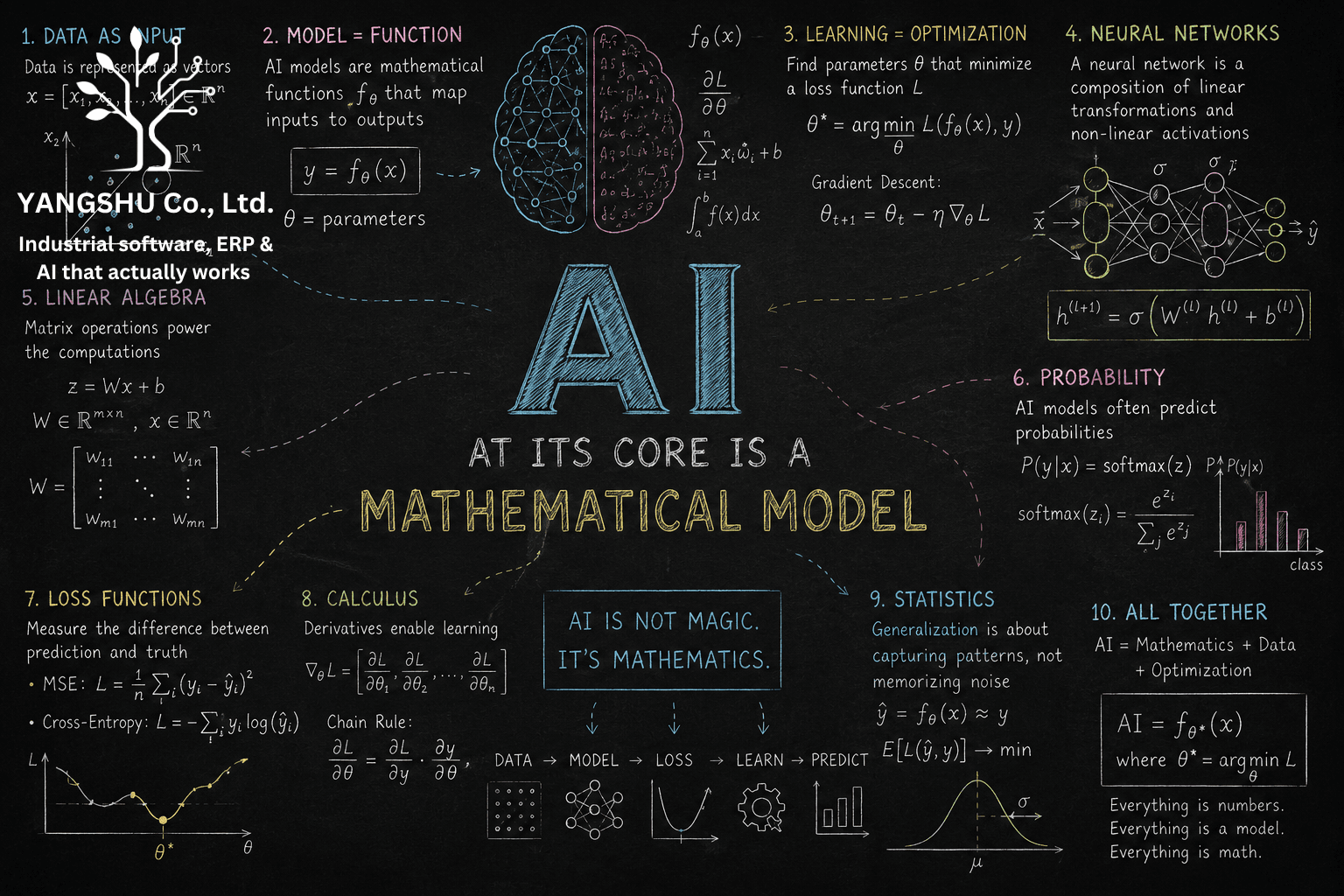
Everyone is talking about AI, and most of that conversation starts with ChatGPT. But before deciding where AI fits in your operation, it helps to understand what these tools actually are underneath the hype. None of it is magic. It is, at heart, mathematics applied to data — and once you see that, it becomes much easier to judge where it can help you and where it cannot.
ChatGPT is a "large language model"
ChatGPT belongs to a family of systems called large language models, or LLMs. The name is literal: it is a very large mathematical model that has been trained on an enormous amount of text — books, articles, websites, code, conversations.
What an LLM fundamentally does is simple to state. Given some text, it predicts what word is most likely to come next. Then it does that again, and again, one word at a time, until it has produced a full answer. That is all it is doing when it writes you a paragraph: making a very long series of "what comes next?" predictions.
The reason it feels intelligent is that to predict the next word well across billions of examples, the model has had to absorb the patterns of how language — and the ideas expressed in language — actually fit together. It is not looking anything up in a database. It is generating, pattern by pattern.
Under the hood: neural networks and a lot of numbers
How does a model "learn" those patterns? Through a structure called a neural network. Despite the brain-inspired name, a neural network is just a large web of numbers — called weights — connected by simple arithmetic. Information enters as numbers, gets multiplied and added through layer after layer of these weights, and comes out the other side as a prediction.
Training is the process of adjusting all those weights. The model is shown an example, makes a guess, and is told how wrong it was. It nudges its weights slightly to be a little less wrong next time, and repeats this billions of times. Over enough examples, those numbers settle into values that capture real patterns. This is what people mean by "machine learning": not a machine that thinks, but a model that tunes its numbers to fit the data it has seen.
It is, in the end, mathematical modeling — fitting a very flexible equation to a very large pile of examples.
The same idea powers far more than chat
Once you see AI as "tune the numbers to fit the data," it becomes clear why the same basic approach shows up almost everywhere:
- Face recognition feeds an image — just a grid of numbers representing pixels — through a neural network trained on many faces, until it can output "this is the same person."
- Quality inspection and machine vision use the identical idea to spot a defect on a production line that a tired human eye might miss.
- Recommendation systems on shopping and video sites predict what you are likely to want next — the same "what comes next?" instinct, applied to behavior instead of words.
- Quantitative trading funds train models on years of market data to predict price movements and place trades automatically.
Different problems, different data, but the same underlying machinery: a model adjusting its numbers until its predictions line up with reality.
Bringing it back to your operation
A practical way to draw the line: hand AI the tasks that don't require deep judgment — turning a meeting recording into clean minutes, running an internal knowledge base that answers employees' routine questions, powering a customer-service chatbot for common requests. These are exactly the kind of repetitive, pattern-shaped tasks LLMs are good at.
Complex tasks — especially anything involving real decisions — are a different matter. You cannot fully trust AI there, for two concrete reasons. First, these models hallucinate: they can produce a confident, fluent, and entirely wrong answer with no visible sign of uncertainty. Second, whatever text or data you feed it is never the complete picture of reality, and the model has no way of knowing what it's missing — so it can reach a conclusion that sounds reasonable but is quietly built on an incomplete or misleading input. Neither failure mode announces itself; both look identical to a correct answer until someone checks.
If you're a manufacturer, AI is already everywhere on the floor and beyond it — face recognition for access control, parking-space detection, self-driving and driver-assist systems — all mature, widely deployed technology at this point, built on exactly the same pattern-matching approach described above. If you're a financial institution, the landscape is even more crowded: new neural-network models for credit scoring, fraud detection, and trading show up constantly, and the sheer number of algorithms in circulation makes "which model" as important a question as "should we use one at all."
The common thread across all of it: AI earns your trust on repeatable, well-bounded tasks with real feedback data behind them. On anything that requires judgment under incomplete information, a human still needs to be the one deciding.
Frequently Asked Questions
Is ChatGPT actually "intelligent," or is it doing something simpler?
Underneath, it's a large language model predicting the next most likely word, one word at a time, based on patterns learned from enormous amounts of text. It feels intelligent because doing that prediction well requires absorbing how language and ideas fit together — but it is not reasoning the way a person does, and it is not looking anything up in a database.
What is a neural network, in plain terms?
It's a large network of numbers, called weights, connected by simple arithmetic. Data goes in as numbers, gets multiplied and added through layer after layer of weights, and comes out as a prediction. "Training" is just the process of adjusting those weights, repeated billions of times, until the numbers capture real patterns in the data.
Is AI used for anything besides chatbots like ChatGPT?
Yes — the same underlying approach (a model tuning its numbers to fit data) powers face recognition, machine vision for quality inspection, product recommendation systems, and quantitative trading models. Different data, different problem, same basic mechanism.
What kinds of tasks is AI actually reliable for in a business?
Repetitive, well-bounded tasks with real feedback data behind them — things like turning meeting recordings into clean minutes, running an internal knowledge base for routine employee questions, or powering customer service for common requests.
What's the right question to ask before applying AI to a business problem?
Not "should we use AI" in the abstract, but "where do we have a decision that gets made repeatedly, where we have data on how it turned out, and where more consistent accuracy would actually matter?"