 Yangshu
What to automate first — a practical guide to RPA
Not every task deserves a robot. Here is how we decide which ones pay off first.
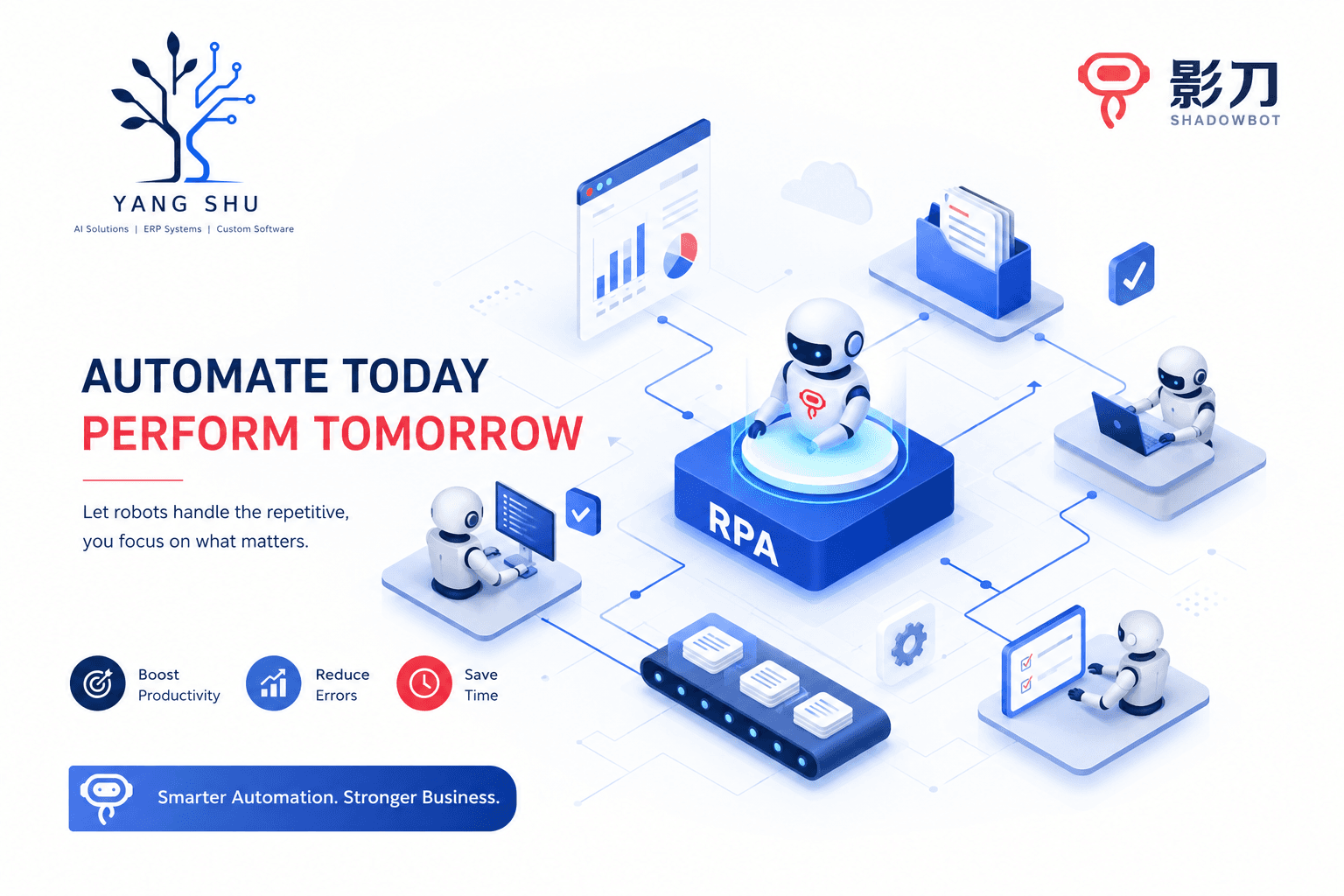
Most teams that come to us about automation already have a list. Monthly reports, data entry between two systems, replying to the same customer questions on Shopee a hundred times a day. The list is never the problem. The problem is knowing which item to automate first, because the order you choose decides whether automation feels like a win or a science project that never quite pays for itself.
After building robots for finance teams, e-commerce sellers, and back offices, we have settled on a simple way to prioritize. It comes down to three questions.
How often does it run, and how predictable is it?
The best first candidate for automation is a task that is high-volume and rule-based. Replying to order-status questions on Lazada and Shopee, pulling the same figures into a monthly report, copying invoice data from a PDF into accounting software — these run constantly and follow rules a person could write down. That predictability is exactly what a robot needs.
A task that happens twice a year, or that requires judgment every time, is a poor first target. Automate the boring, repetitive, every-hour work first. The robot earns back its cost fastest there, and the team feels the relief immediately.
Before you automate: check your goal and your data first
Before reaching for RPA, it's worth pausing on two things: what you're actually trying to accomplish, and what your starting data looks like.
First, get clear on the goal. If what you need is calculation, aggregation, or statistical analysis — turning numbers into other numbers — Python is usually the better tool, not RPA. RPA shines at moving and acting: clicking, typing, copying between screens. It's not built to be a calculation engine. If your task is mostly math, a script will be faster to build and easier to maintain than a robot pretending to use a spreadsheet.
Second, look honestly at your data source. RPA works best when the task follows clear, fixed rules — the same fields, in the same place, every time. If your source data is messy or inconsistent — inconsistent formats, missing fields, unstructured text — the robot will break constantly trying to follow rules that don't actually hold. In that case, the right first step isn't automation at all; it's cleanup. This is exactly where AI can help: using AI to standardize, structure, or clean messy data before RPA ever touches it turns an unreliable process into one with the predictability RPA needs to succeed.
In short: know whether you need a calculator or a robot, and know whether your data is clean enough to hand to either one.
What does an error actually cost?
Some processes are repetitive but forgiving — if a social media auto-reply is occasionally off, a human can follow up. Others are repetitive and unforgiving — a wrong figure in a tax submission or a financial report has real consequences.
We automate the forgiving, high-volume work first to build trust, then move to the higher-stakes processes with proper exception handling: when the robot sees something that does not match the rules, it stops and escalates to a person rather than guessing. That human-in-the-loop design is what makes it safe to automate finance and compliance work at all.
Does the system even have an API?
Plenty of the software businesses rely on every day — older accounting tools, government portals, internal systems — has no clean way to connect. This is where teams assume automation is impossible, and where it actually matters most.
When there is no API, our robots work the way a person does: through the browser and desktop interface, and when needed, using image recognition to see the screen and act. That means we can automate the tools that other approaches cannot touch, which is often exactly where the manual busywork is hiding.
Start small, prove it, then expand
The fastest path to automation that sticks is not a giant program. It is one well-chosen process, automated cleanly, running reliably for a few weeks so the team can trust it. Once that first robot has quietly handed back hours every week, the next candidates are easy to choose — and the business has seen for itself what automation actually delivers.
That is the order we recommend, and the order we build in: highest volume, lowest risk, clearest rules first. Win there, and the rest follows.
Frequently Asked Questions
What is RPA, in simple terms?
Forget the complicated definitions — simply put, RPA is a category of software whose job is to operate other software for you.
What can RPA actually do?
It can operate accounting systems for you, automatically search social media platforms like Facebook for keywords to find potential customers, and bulk-upload products to Shopify or TikTok Shop — saving you from manually uploading hundreds or even thousands of products one by one.
When do you actually need RPA?
In high-frequency, repetitive scenarios. For example, if your company needs to issue invoices to hundreds or thousands of customers every month, but your accounting system can only generate one invoice at a time, that's exactly when RPA can operate your accounting software and automate the invoicing process.
Can I see examples of RPA projects your company has built?
Yes, you can check them out here: https://www.facebook.com/groups/1529252368590078
Can we automate systems that don't have an API, like older accounting tools or government portals?
Yes — RPA works by mimicking the actual actions a human takes to collect or upload data. Our company can even build RPA programs based on image recognition when needed.
Can we hire you to build an RPA program for us?
Absolutely. You're also welcome to check out our portfolio here: https://www.facebook.com/groups/1529252368590078
What are the main challenges in building RPA programs?
For web pages, identifying and capturing the right elements is one of the biggest challenges — and if a website's layout changes, the RPA program needs to be updated to match. Network latency and anti-RPA detection on some websites are also difficult issues, often requiring mechanisms like randomized wait times to work around.