 Yangshu
What ERP modernization actually looks like
Replacing a legacy system is less about features and more about how work really flows.
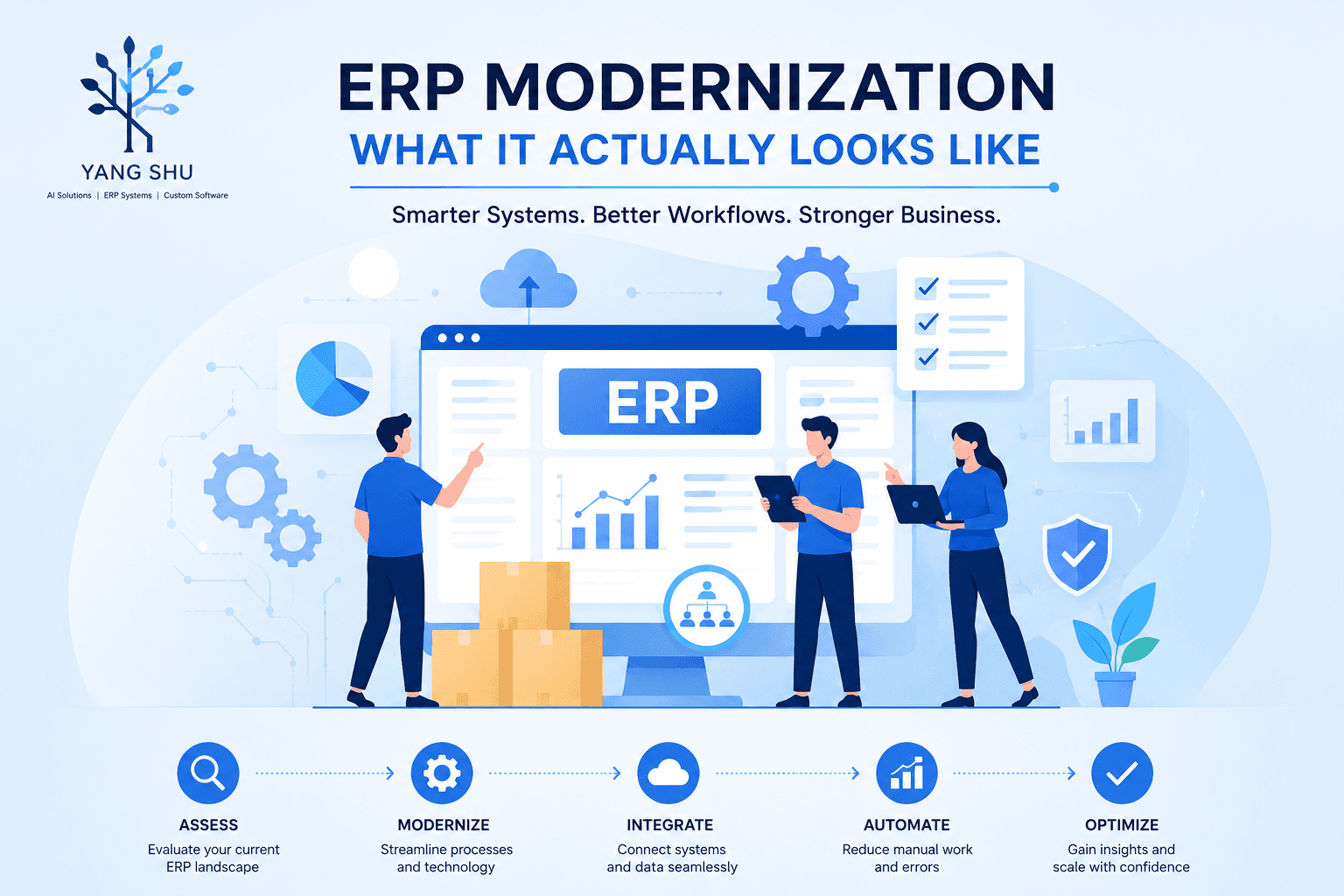
Most companies that decide to modernize their ERP are not doing it because they want new features. They are doing it because the old system has become a daily obstacle — workarounds are piling up, data lives in spreadsheets beside the system instead of inside it, and getting a simple report takes longer than it should.
The hard part of ERP modernization is not the technology. It is the process of uncovering how work actually flows through the business, which is almost never how it looks on paper.
Start with the gap between process and reality
Every company has an official process — the one in the manual, the one that was configured when the old system went live. And then there is the real process: the one that actually runs the business, full of workarounds, undocumented steps, and tribal knowledge held by two or three people.
Within that gap, two issues tend to matter most. The first is process drift against new business models. If the old system was never built to support a new line of business and the company keeps forcing that new business through it anyway, people get frustrated — and worse, the raw data and the numbers that come out of it start to become unreliable. The second is a conflict of goals. Management and frontline staff experience the ERP from opposite ends: leadership often wants many things out of it — dashboards, statistics, reports — while the people entering the raw data at the source frequently don't have the time to keep up with all of it. When that happens, the system quietly becomes less and less useful, no matter how many reports it's configured to produce.
Data migration is where timelines break
Every ERP project that has run significantly over schedule has a data migration problem at the root. Old systems accumulate years of messy, inconsistent, sometimes contradictory data. Migrating it is not a copy-paste operation — it requires decisions about what to keep, what to clean, and what to leave behind, and those decisions require business judgment, not just IT work.
This is also where the client's cooperation matters most — not just handing over data, but helping sort through it and, critically, confirming how each statistic was actually defined and calculated. Consultants need to have that conversation directly with the client: will this definition change under the new system, or does it need to stay the same? A lot of messy data isn't carelessness — it's the residue of old bugs, old workarounds, or simply a client team too stretched to have ever cleaned it up. In those cases, the right move is to negotiate it together; often we end up helping the client organize their own data as part of the project, not as a favor outside it.
Adoption is the real delivery
A technically perfect ERP that nobody uses is not a successful project. Adoption is the real measure of delivery — and it starts long before go-live.
The teams who will use the system need to be involved in the design. Not just informed at the end, not just trained two weeks before launch, but actively involved in defining workflows, validating the build, and owning the configuration for their part of the business. That involvement is what separates an ERP that becomes the way the business runs from one that becomes the system everyone has to log into but nobody trusts.
What modernization actually delivers
Through all of this, leadership needs to understand that rushing the timeline is not a good trade. Testing and deployment are a medium-to-long process by nature, because the system has to satisfy three different audiences at once: the working habits of frontline staff, the reporting demands of middle management, and the senior leadership's need to trust the data enough to act on it. Getting those three to cooperate — and sometimes compromise with each other — is as much an art as it is a project plan.
When it goes well, ERP modernization does not feel like a big technology project. It feels like the business running more cleanly. Orders move through without manual re-entry. Finance closes the month without chasing data from five different sources. Management has a view of the business that is current, not three days old.
That is the outcome to hold in mind when the project gets complicated — and it will get complicated. The complexity is real, but so is the destination.
Frequently Asked Questions
Why map the "real" process instead of just using what's already documented?
Because the documented process and the actual working process are almost never the same. The undocumented workarounds and tribal knowledge are exactly what the new system needs to account for — skip this step and the gaps surface later, usually during rollout.
What happens if the old ERP doesn't support a new business model we've already started running?
Forcing new business through a system that wasn't built for it tends to frustrate the people using it daily, and over time it corrupts the underlying data and statistics. That mismatch is one of the clearest early signals that modernization is overdue.
Why does data migration cause so many delays?
Because it's not copy-paste — it requires real decisions about what data to keep, clean, or discard, and those decisions need business judgment, not just IT execution. Years of accumulated inconsistencies don't sort themselves out quickly.
Who needs to be involved in cleaning up the old data?
The client, directly. Beyond just handing over files, someone needs to confirm how each statistic was actually being calculated under the old system, and whether that definition should carry over or change. Where the client's team is too stretched to do this alone, it's normal — and often expected — for the implementation team to help sort it out together.
How do you measure whether an ERP project actually succeeded?
Adoption, not technical completeness. A system nobody trusts or uses isn't a successful delivery, no matter how well it was built.
Why do management and frontline staff often want different things from the same system?
Leadership tends to want more reports, dashboards, and statistics; frontline staff are the ones who have to enter the raw data behind all of it, often without enough time to do so. If that imbalance isn't managed, the system slowly becomes less useful to everyone.
What does a successful modernization actually feel like day to day?
Less like a big tech rollout and more like the business simply running cleaner — orders that don't need re-entry, month-end closes that don't require chasing five spreadsheets, and management with a current view of the business instead of one that's days old.