 Yangshu
Custom ERP in Thailand: AI-Native Industry ERP Guide
How custom ERP in Thailand differs from Odoo, which industries need it, and how built-in AI OCR and RPA automate bank reconciliation and receivables.
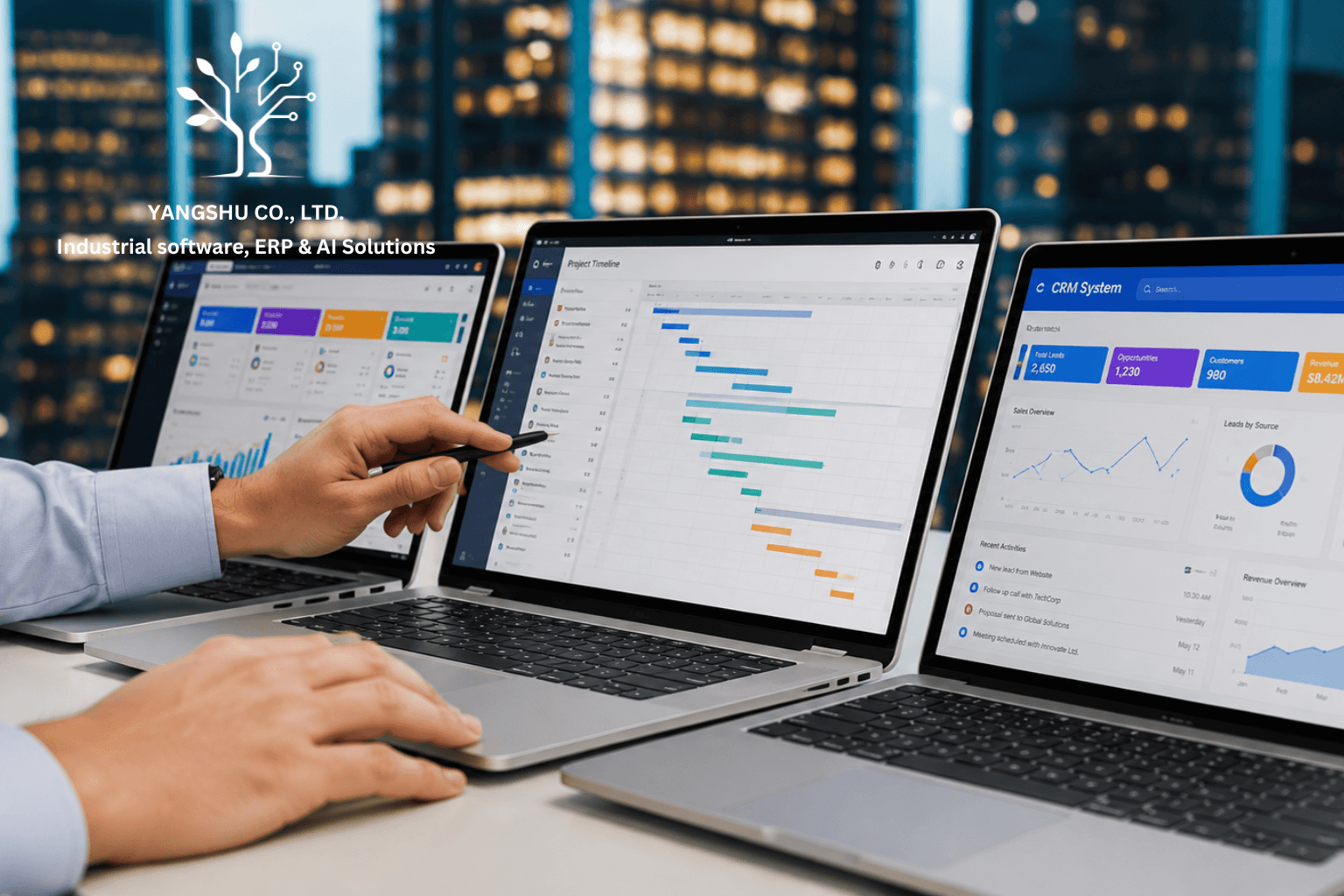
Summary: Custom ERP is enterprise resource planning software built around a company's real processes, rather than software that forces the business to fit a preset template. Yangshu Co., Ltd is a Thailand-based custom enterprise software developer with R&D centers in both Thailand and China, and Yangshu builds industry-specific ERP for manufacturing, logistics, retail, leasing, veterinary care, wholesale, e-commerce, and legal firms — with AI OCR, an AI knowledge base, and RPA automation built in natively rather than bolted on afterwards. Compared with off-the-shelf suites, custom ERP fits local workflows such as PromptPay reconciliation, hire-purchase offset sequencing, dynamic penalty interest, and cross-system data synchronization. This guide covers how custom ERP differs from generic options like Odoo, which Thai industries need it most, what "ERP with AI" actually means, and how to automate bank reconciliation, accounts receivable, quotations, and inventory.
What is custom ERP, and how is it different from Odoo and other off-the-shelf suites?
Custom ERP is developed around your actual processes, whereas off-the-shelf ERP — Odoo or the standard SAP suite, for example — expects the business to run the way the software prescribes. The core difference is not the number of features but who adapts to whom: generic suites cover common needs with a set of standard modules, while custom ERP designs its data structures and workflows around one industry or one company.
That does not make custom always the better answer. Off-the-shelf ERP suits companies with standard processes, limited budgets, and a need to go live quickly; open-source Odoo has a low entry cost and a mature module ecosystem, which makes it a sensible starting point for many SMEs. Custom ERP suits companies whose processes are unusual, hard to cover with generic modules, or that require deep integration with local banking, tax, or legacy systems. Forcing a generic template onto those processes usually leads to heavy re-development plus offline Excel patches — ending up more expensive and harder to maintain than a purpose-built system.
| Dimension | Off-the-shelf ERP (e.g. Odoo, standard SAP) | Custom industry ERP |
|---|---|---|
| Process fit | The business adapts to preset workflows | The software fits your real workflows |
| Upfront cost | Lower; modules work out of the box | Higher; needs discovery and development |
| Unique or local requirements | Depend on customization; may be limited | Supported natively at the data-model level |
| System integration | Mostly standard connectors | Non-invasive integration with SAP, Oracle, and legacy systems |
| Best for | Standard processes, fast go-live | Unique processes, strong industry specifics, deep integration |
Yangshu follows a "Discover & Design" approach: understand how the business actually runs first, then decide what to handle with standard modules and what to build custom — rather than starting from a template and negotiating downwards. We have written before about what ERP modernization actually looks like when a system has become a daily obstacle instead of a tool.
Why do Thai manufacturers and logistics firms need industry-specific ERP?
Because manufacturing and logistics are pillars of Thailand's economy, and both carry complex, highly localized processes that generic templates rarely cover in one pass. According to the World Bank's 2026 Thailand Economic Monitor, manufacturing accounts for about 25% of Thailand's GDP and roughly 6.2 million jobs, anchoring export-driven sectors such as electronics, automotive, and food processing. Scheduling, materials, cost accounting, and warehouse operations in these sectors tend to carry a great deal of industry-specific logic.
At the vertical level, the value of custom ERP lies in encoding industry rules into the system itself:
- Food factory ERP: batch traceability, shelf life and FIFO, recipe and yield management.
- Plastic factory ERP: injection-molding steps, regrind ratios, mold and machine scheduling.
- Construction and project ERP: project-based costing, progress billing and subcontractor management, material issuance.
- Warehouse ERP: bin management, picking routes, inter-warehouse transfers, and real-time inventory.
None of those four lists is a feature request that a standard module can satisfy by configuration alone — each one changes what the underlying records have to look like. For manufacturers, Yangshu also builds cutting optimization software for wood and metal processing, which uses nesting algorithms to calculate the most material-efficient cut plan on the factory floor and reduces raw-material waste directly.
What does "ERP with AI" actually mean?
"ERP with AI" means AI OCR, an AI knowledge base, and RPA are integrated into the ERP natively, so the system does more than record data — it reads documents, answers questions, and runs processes on its own. It pulls work that used to sit in manual steps and offline spreadsheets back into a single system loop.
AI OCR, including invoice OCR
AI OCR extracts structured data from scanned documents automatically. Yangshu's AI OCR reads invoices, receipts, bank cheques, ID documents, forms, and contracts, and is tuned for Thai bank statements, cheques, and transfer screenshots, with output as JSON or CSV or straight into Flows ERP.
The case for it is well documented. Manual field-level data entry carries an error rate of roughly 1% for skilled operators and up to 4% under typical conditions, per long-running research such as Barchard & Pace (2011). IOFM benchmarks put the cost of processing a single invoice manually at about US$15, falling to roughly US$2–3 once automated (data-entry cost benchmarks, 2026). McKinsey estimates that about 42% of finance activities are automatable with current technology, and Deloitte research finds AI document processing can cut error rates by roughly 75–90% versus fully manual work.
AI knowledge base
An AI knowledge base turns manuals, SOPs, policies, and contracts into a system you can query in natural language. Ask in Thai, English, or Chinese and get an answer with an exact source citation, not a list of keyword hits. New hires stop spending their first weeks working out where information lives — they ask, and the system answers from the company's own documents.
Inventory AI
Inventory AI applies demand forecasting and replenishment suggestions on top of the stock and sales data the ERP already holds, which reduces stockouts and dead stock at the same time. This works precisely because the data is already inside one system; forecasting on top of scattered spreadsheets is where most attempts fail.
How do you automate bank reconciliation and accounts receivable with AI OCR and RPA?
The core of automated bank reconciliation is using AI OCR to turn bank statements and payment slips into structured data, then using RPA to match them line by line against receivables and invoices in the ERP, leaving staff to review only the exceptions.
In Thailand this matters acutely. According to Bank of Thailand data, PromptPay processed about 27.3 billion transactions in 2025 — up roughly 12.8% year on year — with over 90 million registrations and more than 74 million transactions a day. That is an enormous volume of instant, small-value transfers, and every one of them eventually has to be matched to an invoice by somebody.
A practical automation flow looks like this:
- Capture. AI OCR extracts fields such as amount, date, payer, and reference number from bank statements, PromptPay transfer screenshots, and cheques.
- Match. RPA software robots compare the extracted results line by line against accounts receivable, invoices, and orders in the ERP.
- Reconcile and flag exceptions. Matched items clear automatically; mismatches in amount or reference number are raised as exceptions for human review.
- Sync. Results are synchronized both ways back into the ERP, or into SAP, Oracle, and other systems, with no manual re-entry.
A key advantage of RPA here is non-invasive integration: even when connecting to SAP, Oracle, or an unsupported legacy system, two-way data sync works without modifying the original system. The deeper problem this solves — losing sight of what customers actually owe you — is one we have covered in detail in closing the business–finance gap in accounts receivable.
Client case — XCMG Leasing (Thailand) Co., Ltd. This hire-purchase and leasing company uses Yangshu's AI and OCR reconciliation tool to import monthly cheque-clearing results into Flows ERP automatically, saving roughly one employee about three days of reconciliation work every month.
How do you standardize quotation, purchasing, and inventory in one ERP?
You standardize them by linking quotation, purchasing, and inventory into a single data chain with approvals and an audit trail, instead of scattering them across email and Excel. Once a quotation is confirmed it generates a sales order, which triggers purchase requisitions and approval flows; when purchased goods are received into stock, inventory and cost update automatically, and receivables and payables are generated together with the documents.
The direct payoff is less repeated entry and fewer inconsistencies. One set of data flows across quotation, order, purchasing, inventory, and finance, rather than being keyed in again at every step — which is also what makes month-end close fast, because there is nothing left to reconcile between systems. For sales and leasing companies, Yangshu's Flows platform additionally builds in industry logic such as hire-purchase offset sequencing, dynamic penalty interest, and asset management.
How should a Thai company select and roll out custom ERP?
Start with a single, highest-value use case and prove it before expanding, rather than launching every module at once. Yangshu's delivery follows "Discover & Design": map how the business actually runs, then design the architecture and workflows, then have the cross-border team deliver in agile iterations, with maintenance and training continuing after go-live.
A workable selection sequence:
- Name the bottleneck, not the module. "Reconciliation takes three days a month" is a scope; "we need finance ERP" is not. Our guide to what to automate first sets out the three questions worth asking before anything is built.
- Check what has to be integrated. Existing SAP, Oracle, bank portals, or a legacy system without an API will shape the architecture more than the feature list will.
- Decide where the data lives. On-premise or private cloud keeps documents inside your own environment; the underlying models can be cloud services such as OpenAI, Anthropic, or Google, or open-source models like DeepSeek deployed on your internal network.
- Run a pilot with a measurable before-and-after. Per Yangshu, a pilot focused on one document set or use case can typically be running within 2 to 4 weeks.
- Expand only once the pilot holds. Each additional module should inherit the same data model, not start a new one.
Key takeaways
- Custom ERP fits the software to the business; off-the-shelf ERP fits the business to the software. Neither is universally better — the deciding factors are process complexity and integration depth.
- Odoo and similar suites remain a sensible choice for standard processes and fast go-live; custom ERP earns its cost where generic modules would need heavy re-development.
- Industry logic — batch traceability, mold scheduling, progress billing, hire-purchase offset sequencing — belongs in the data model, not in spreadsheets beside the system.
- AI OCR plus RPA is what turns bank reconciliation and accounts receivable from a monthly manual exercise into an exception-review task.
- Non-invasive RPA integration means SAP, Oracle, and legacy systems can stay exactly as they are.
- Start with one high-value use case, prove it in 2 to 4 weeks, then expand on the same data model.
External data in this article is drawn from the World Bank, the Bank of Thailand (ธปท.), and public research by McKinsey, Deloitte, and IOFM, with source links provided.
Frequently Asked Questions
Is custom ERP always more expensive than Odoo?
Not necessarily. Custom ERP usually carries a higher upfront cost, but when processes are unusual and generic modules would need heavy customization, the long-run total cost can be lower. Companies with standard processes are often better served by an off-the-shelf suite such as Odoo. It depends on process complexity and integration depth, so a needs assessment should come before the buying decision.
Will our data leave our own environment?
It does not have to. Yangshu supports on-premise and private-cloud deployment and can run open-source models inside your own network, so documents never enter a shared public AI service. Role-based access control also lets you decide who is allowed to query what.
Can AI OCR read Thai bank statements and cheques?
Yes. Yangshu's AI OCR is tuned for Thai bank statements, cheques, and transfer slips, and extracts fields such as payer, amount, date, and account number. It handles batch processing, and results can be exported as JSON or CSV or pushed straight into Flows ERP.
Does the system support Thai, English, and Chinese?
Yes. The ERP interface and the AI knowledge base support Thai, English, and Chinese natively, and the knowledge base can handle a mixed-language document library — a question asked in Thai can be answered from an English or Chinese source document.
Can you integrate with our existing SAP, Oracle, or legacy systems?
Yes. Yangshu uses RPA software robots for non-invasive integration, so cross-system workflows and two-way data synchronization run without modifying the original system — which matters most for legacy systems that have no API or are no longer supported by their vendor.
Which industries does Yangshu build ERP for?
Yangshu builds industry-specific ERP for manufacturing, logistics, retail, leasing and hire-purchase, veterinary care, wholesale, e-commerce, and legal firms, plus cutting-optimization software for wood and metal processing. Industry rules are encoded in the data model rather than patched on afterwards.
How long does a custom ERP take to go live in Thailand?
Per Yangshu, a pilot focused on a single high-value use case — one document set or one process, such as bank reconciliation — can typically be running within 2 to 4 weeks, after which it expands to further modules and processes. Full multi-module rollouts take longer and depend on scope.