 Yangshu
Did we make our tools, or did our tools make us?
A short reflection on an old question that feels newly urgent — and what it means for how we build.
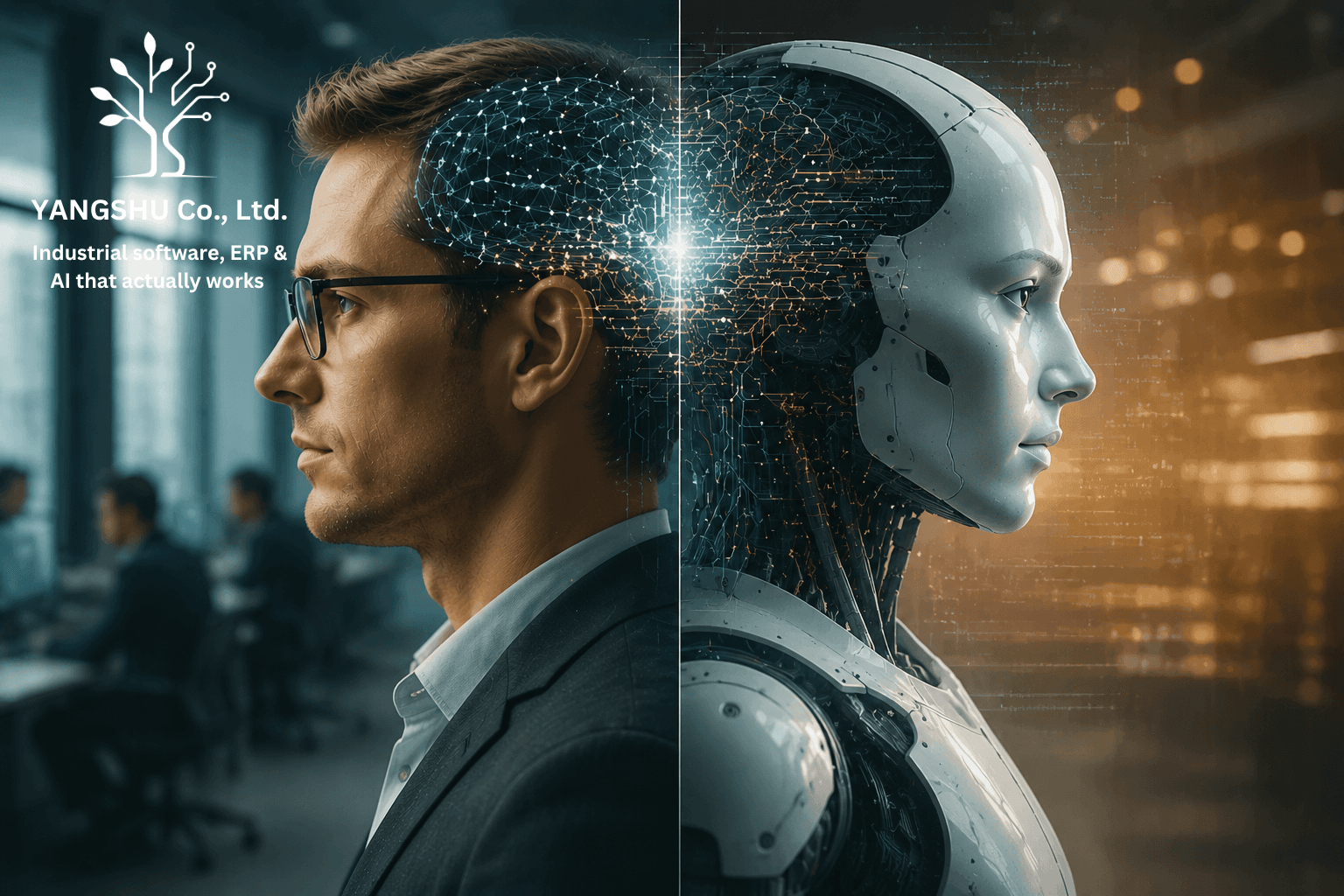
We like to tell a simple story about technology: humans are clever, humans have needs, and so humans invent tools to meet them. The hand came first, then the hammer. In that story we are firmly in charge — the maker, the author, the one who decides. Tools are just things we pick up and put down.
It is a comforting story. It is also only half of one.
The other direction
Look closely and the arrow seems to point both ways. We shaped the first stone blades — but the act of making and using them, generation after generation, is part of what shaped our hands, our brains, and even the way we cooperate. The tool was not only an output of who we were. It quietly helped decide who we became.
Take something as basic as sleep. For most of human history, an eight-hour block at night was not the norm. In much of ancient China — and in pre-industrial Europe too — people would often go to bed not long after sunset, around six or seven in the evening, then wake in the middle of the night, around three or four, for an hour or two of quiet reading, prayer, or conversation, before sleeping again until morning. It was a rhythm built around the sun, because the sun was the only light anyone had. Then came the electric light. Suddenly the night could be filled — with work, with socializing, with shopping, with entertainment that ran past midnight. Nobody invented the light bulb to change how humans sleep. But it did anyway, rewriting a rhythm that had held for thousands of years within a couple of generations. We made the light. The light remade us.
How AI will change us
AI is going to enter everyone's life — not eventually, but within the next few decades, and this is the premise our company, Yangshu, was built on. AI will help people who cannot hear or speak to do both. It will help doctors diagnose. It will help office workers get their work done. Beyond that, we honestly don't know exactly how AI will change us — nobody can predict the future with precision.
But here is one thing we do think will happen: AI will speed up change to the point that it unsettles people psychologically. It will push people toward a kind of anxiety, even a loss of confidence, because there are tasks — intellectual ones — where a person is simply not as capable as the AI. And at the same time, AI will make people feel unusually confident: with AI beside them, anyone can feel like they've become a professional doctor, a professional programmer. So people will swing between overconfidence and self-doubt, and land in a deeper kind of confusion than either feeling alone would cause.
How we face the AI era
The first thing to be clear about: today's AI cannot replace people. There's a view we find genuinely useful — that human intelligence isn't only linguistic or knowledge-based. We also have spatial intelligence, physical/motor intelligence, and aesthetic intelligence. Playing basketball, listening to music, standing in front of a painting and feeling something — none of that is something AI can do. Large language models, for all their fluency, are still essentially imitating human speech. They don't have a grounded sense of real time, they don't reliably grasp cause and effect or physical law, and they're nowhere near motor intelligence at all.
What matters going forward, we think, is simple: don't be anxious. AI replacing humans, if it happens at all in any complete sense, is decades away — our careers are long enough to outlast that horizon. What's worth investing in instead is what AI still can't touch: how you relate to other people, how you make a friend, how you comfort someone who's struggling, your creativity, your particular way of seeing things. That is what will still be yours in the AI era.
We have always made our tools. Our tools have always, in return, made us. Whatever AI turns out to be, that loop isn't going to stop — the only real choice we have is how awake we stay to it.
Frequently Asked Questions
Is AI going to replace human jobs?
Yangshu's view is that today's AI cannot replace people, and any full replacement — if it happens at all — is likely decades away. Careers built today have a long runway before that horizon becomes relevant.
If AI can write, talk, and even code, isn't that already close to human intelligence?
Not quite. Yangshu sees language fluency as only one form of intelligence. Humans also have spatial intelligence, physical/motor intelligence, and aesthetic intelligence — playing basketball, listening to music, feeling something in front of a painting. Large language models are, at their core, imitating human speech; they don't have a grounded sense of real time, and they don't reliably understand cause and effect or physical law.
Why do people feel both more confident and more anxious because of AI?
We observed that AI can make people feel like instant experts — as if having AI beside them turns anyone into a professional doctor or programmer — while at the same time creating anxiety and self-doubt, because there are cognitive tasks where people are simply outperformed by AI. That swing between overconfidence and insecurity is, in our experience, one of the more disorienting psychological effects of AI adoption.
What should someone actually focus on to stay relevant in the AI era?
We would point to the things AI still can't do: building real relationships, comforting someone who's struggling, creativity, and your own distinct point of view. These are what we consider a person's real footing as AI becomes more capable.
What role does Yangshu see AI playing in everyday life?
Yangshu was built on the premise that AI will enter everyone's life within the next few decades — helping people who cannot hear or speak to do both, helping doctors diagnose, and helping office workers get their work done.